The Berthiaume Institute for Precision Health (BIPH) at the University of Notre Dame (USA) and the Dublin City University (Ireland) Life Sciences Institute (LSI) have announced the recipients of the second annual Notre Dame-DCU Exchange Grant in Precision Biomedical Technologies.
The competitive funding program is designed to support high-impact, collaborative research between faculty at the University of Notre Dame and Dublin City University (DCU) in the field of precision biomedical technologies, with a special emphasis this year on the physical exchange of personnel and knowledge between the two institutions.
“This continued partnership between the Berthiaume Institute for Precision Health and Dublin City University’s Life Sciences Institute strengthens the international connections that are essential for addressing complex biomedical challenges,” said Matthew J. Webber, Keating-Crawford Collegiate Professor of Engineering and acting director of BIPH. “By enabling researchers and trainees to work directly across institutions, our exchange grants create new opportunities for scientific discovery while advancing Notre Dame’s role as a global research university.”
By leveraging interdisciplinary expertise across both institutions, the awarded projects will drive scientific discovery and technological innovation in the biomedical field, spanning sensors and diagnostics, novel therapeutics, and the interface between human health and the environment.
“Fresh from my own exchange visit to Notre Dame, I’m delighted we can build on our institution’s collaborative momentum with this 2026 round of funding,” said Professor Anne Parle, director of the DCU’s LSI in Dublin, Ireland. “The physical exchange of our awardees brings that extra ingredient to ensure these collaborations lead to a tangible success.”
2026 Awardees of the Notre Dame-DCU Exchange Grant in Precision Biomedical Technologies
“Overcoming PARP Inhibitor Resistance in High-Grade Serous Ovarian Cancer Through HSP90β-Selective Inhibition,” Brian Blagg (ND) and Neil Conlon (DCU)
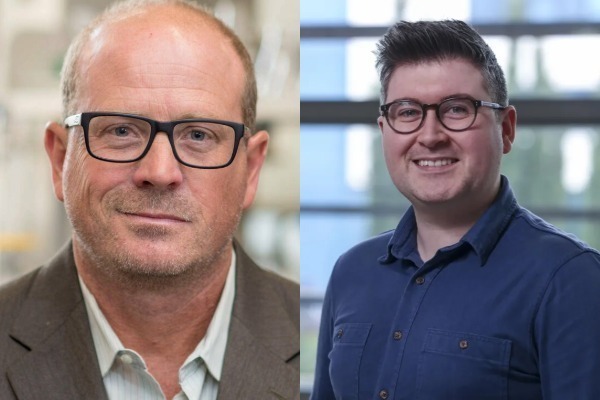
Brian Blagg, the Charles Huisking Professor of Chemistry and Biochemistry and director of the Warren Family Research Center for Drug Discovery and Development, brings more than two decades of expertise in designing isoform-selective HSP90 inhibitors as anti-cancer agents. His team developed NDNB25, an HSP90β-selective inhibitor with nanomolar potency and favorable bioavailability, which the collaboration will evaluate for its ability to resensitize PARP-inhibitor-resistant ovarian cancer.
Neil Conlon, assistant professor in biotherapeutics and group lead of the Breast and Gynecological Oncology Research Group at DCU, focuses on the pre-clinical evaluation of novel cancer therapies and mechanisms of drug resistance. His lab has established a panel of ovarian cancer cell lines with acquired resistance to FDA-approved PARP inhibitors and applies advanced platforms, including 3D bioprinted tumor models and kinomic pathway analysis, to dissect resistance and identify sensitizing strategies.
The collaboration integrates Notre Dame’s strengths in medicinal chemistry and drug discovery with DCU’s advanced preclinical evaluation platforms. Blagg will travel to DCU to deliver a guest lecture and work to foster a sustainable, long-term partnership, while the research teams collaborate to generate pilot data.
“Point-of-Use Electro-Physical Separation of Environmental DNA (eDNA) from Cellular/Organism Contributions in Complex Samples Preserving Both Populations for Analysis,” Matthew Champion (ND) and James Landers (DCU)
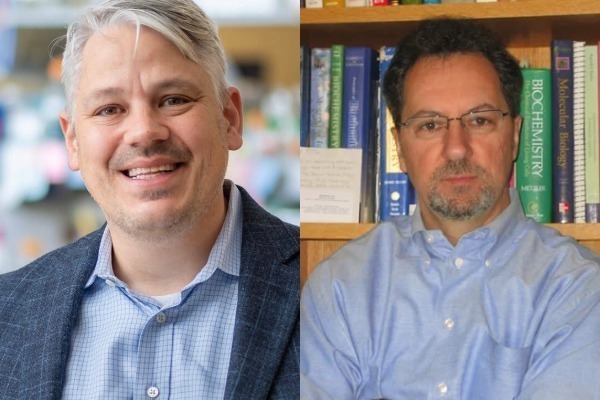
Matthew Champion, associate professor in the Department of Chemistry and Biochemistry, develops bioanalytical and separations tools to probe the biology of bacteria, their communities, and their viruses. His lab has pioneered a capillary zone electrophoresis (CZE) technique that separates intact organisms and cells from complex environmental samples non-destructively, cleanly partitioning whole cells from free extracellular DNA for downstream analysis.
James Landers, SFI Research Professor and director of the RAPID (Research Advances in Personalized Integrated Diagnostics) Institute at DCU, is a world leader in the miniaturization of microfluidic devices for genetic analysis and point-of-care diagnostics. His group has developed fully integrated, sample-in-answer-out microfluidic systems and low-cost, rapid separation platforms that translate laboratory-scale assays into deployable devices.
The collaboration pairs Champion’s expertise in microbial separations and organismal manipulation with Landers’s leadership in microfluidic miniaturization. Champion, alongside a research scientist and a graduate student, will travel to DCU to adapt the laboratory-scale CZE into a miniaturized point-of-use device, with a reciprocal visit from the Landers group envisioned to test prototypes at Notre Dame.
“Functionalized Carbon Nano-Onion for Therapeutic Delivery Across Biophysical Barriers in Glioblastoma,” Meenal Datta (ND) and Silvia Giordani (DCU)
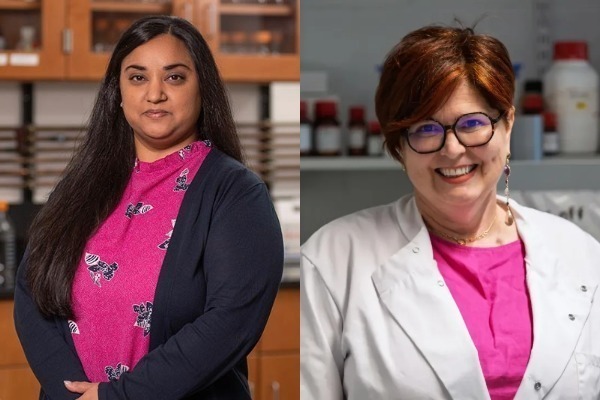
Meenal Datta, the Jane Schoelch DeFlorio Collegiate Professor of Aerospace and Mechanical Engineering, leads the TIME (Tumor Immune Microenvironment and Mechanics) Lab, which studies how the physical microenvironment of tumors shapes disease progression and treatment response. Her group has pioneered in vitro and in vivo compression models that reproduce the solid-stress conditions characteristic of glioblastoma, enabling precise study of how mechanical forces alter cellular behavior and the transport of therapeutics.
Silvia Giordani, full professor and chair of nanomaterials in DCU’s School of Chemical Sciences, is an internationally recognized leader in carbon nanomaterials for biomedical applications. Her group specializes in the synthesis and surface functionalization of carbon nano-onions (CNOs) which are ultra-small, biocompatible, multi-layered fullerene nanostructures including near-infrared fluorescent variants engineered for targeted drug delivery and intracellular imaging.
The collaboration bridges DCU’s advanced nanomaterials expertise with Notre Dame’s specialized mechanobiological testing frameworks through reciprocal personnel residencies. A DCU researcher will spend time in Datta’s TIME Lab tracking nanoparticle transport in 3D glioblastoma organoids under mechanical compression, while a Notre Dame researcher will visit DCU to validate the biocompatibility of the engineered CNO platform.
“Multimodal Electrochemical Sensing for Ultra-Sensitive and Chemically Specific PFAS Detection,” Bryan Paulsen (ND) and Éadaoin Carthy (DCU)
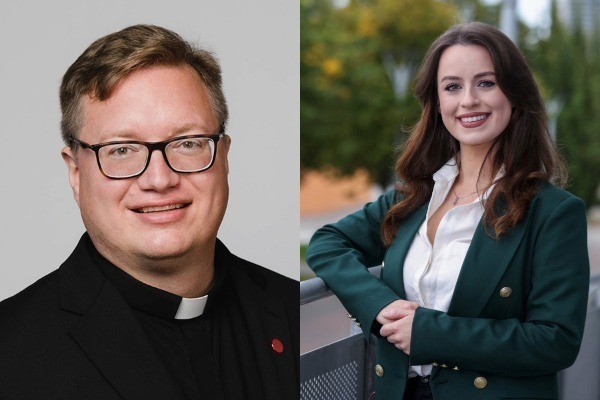
Bryan Paulsen, assistant professor in the Department of Chemical and Biomolecular Engineering, studies organic mixed ionic-electronic conductors and conductive-polymer transducers for electrochemical sensing. His lab has demonstrated a low-cost PFAS indicator capable of detecting PFOA down to femtomolar concentrations — an unprecedented level of detection.
Éadaoin Carthy, assistant professor in DCU’s School of Mechanical and Manufacturing Engineering and deputy director of innovation at the RAPID Institute, develops translational microfluidic lab-on-a-disc/chip technologies, biosensors, and point-of-care diagnostics. Her group has developed molecularly imprinted polymer (MIP) screen-printed electrodes for the selective detection of PFOA and other individual PFAS compounds, providing molecularly specific sensing in a portable, field-deployable format.
The collaboration will unite Notre Dame’s ultra-sensitive PFAS indicator with DCU’s molecularly selective sensors into a single multimodal, field-deployable workflow. Through a two-way trainee exchange — a Notre Dame doctoral student traveling to DCU and a DCU postdoctoral researcher visiting Notre Dame — the teams will transfer fabrication and testing protocols directly between laboratories.
The funded projects will proceed over a one-year term, during which the teams will exchange personnel, develop their technologies, conduct proof-of-concept studies, and explore pathways for future external funding.
For more information about the Notre Dame-DCU Exchange Grant in Precision Biomedical Technologies and future rounds of applications, please visit the BIPH website.
Contact: BIPH@nd.edu and lsi@dcu.ie